


Home: Medical
Please Note: Not all of the objects on this website are on display at the museum.
|
Medical equipment, induction coils, and quackery |
Quackery, The Electrical Snake Oil |

Larger image |
COLLISON INHALER, 1940 The Collison Inhaler is for the administration of measured quantities of drugs to the lungs using Oxygen from bottles. It consists of two phials for the medication a face mask and rubber tubing a chromed assembly of two valves and the input points for the phials, also are two controls, one marked ‘'Both phials, White phial, Amber phial and Only oxygen’’. The other control is marked, ‘’Off, Weak, Medium, and Full’’; an indicator is also fitted to measure the level of oxygen left in the cylinder, but the plastic is fogged and the inside can barely be read. A1829 |

Larger image |
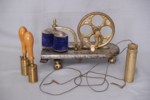
MAGNETO MEDICAL COIL, circa 1900 Magneto type Medical Coil the handle on the front has to be turned to produce the voltage. This equipment was used for a variety of medical cures, in the early 20th Century Nicola Tesla experimented on many machines that could produce high voltages, he found that his machines could invigorate all parts of the body with surprising results. Later it was proved medically that applying electric charges could produce improvements to certain ailments. As a result these machines were made in there thousand and sold to the general public, they were also used by doctors and also people Masquerading as such and charging for the treatment, these persons were known as 'Quacks' as they claimed that this treatment would cure anything. It was Michael Faraday who first invented magnetic induction coils in 1831. This machine uses this principal to produce the voltage. A1743 |

Larger image |
ROGERS 'VITALATOR' MEDICAL COIL, 1930's Also known as a Violet Ray machine as the tools glow violet in colour when in use. This equipment was used for a variety of medical cures.The Induction Coil principal was discovered by Michael Faraday (1791-1867) in 1831, followed by Nicolas Callan who made a coil that produced very high voltages in1836. Heinrich Ruhmkorff perfected his version of this machine, which could efficiently produce high voltages, complete with an interrupter contact to create the alternating current necessary for it to work. These machines are now called 'Tens' machines. This machine operates on that principal. They were used for medical complaints such as skin disorders, and to power X ray machines. Marconi used one for his transmitter system at Poldhu in Cornwall for the first transatlantic transmission.in the early 20th Century Nicola Tesla experimented on many machines that could produce high voltages, he found that his machines could invigorate all parts of the body with surprising results. Later it was proved medically that applying electric charges could produce improvements to certain ailments. As a result these machines were made in there thousand and sold to the general public, they were also used by doctors and also people Masquerading as such and charging for the treatment, these persons were known as 'Quacks' as they claimed that this treatment would cure anything. A1741 |

Larger image |
'MEDICOLUX' MEDICAL COIL., 1930's Also known as a Violet Ray machine as the tools glow violet in colour when in use. The Induction Coil principal was discovered by Michael Faraday (1791-1867) in 1831, followed by Nicolas Callan who made a coil that produced very high voltages in1836. Heinrich Ruhmkorff perfected his version of this machine, which could efficiently produce high voltages, complete with an interrupter contact to create the alternating current necessary for it to work. These machines are now called 'Tens' machines. This machine operates on that principal. They were used for medical complaints such as skin disorders, and to power X ray machines. Marconi used one for his transmitter system at Poldhu in Cornwall for the first transatlantic transmission.in the early 20th Century Nicola Tesla experimented on many machines that could produce high voltages, he found that his machines could invigorate all parts of the body with surprising results. Later it was proved medically that applying electric charges could produce improvements to certain ailments. As a result these machines were made in there thousand and sold to the general public, they were also used by doctors and also people Masquerading as such and charging for the treatment, these persons were known as 'Quacks' as they claimed that this treatment would cure anything. A1740 |

Larger image |
REX ELECTRIC MAGNETO BRUSH, circa 1910 REX Electric Brush using a Magneto as a power source, power is obtained by pressing the lever on the side continually, the power can be adjusted by a plate on the back of the brush by pulling out for more power, this would be low in voltage just enough for the operator to feel it if held in one spot for long enough. Used to regenerate lost hair or helping with Eczema or other skin complaints. It comes with its original box which has the instructions inside the lid. The instruction recommend the bristles be wetted with a felt pad supplied with the unit, this is missing. A1731 |

Larger image |
MEDICAL COIL MADE BY K.SCHALL & SON, circa 1930 This unit was used to treat skin conditions such as excema or exema (sic), and dermatitis as well as other skin complaints. A1658 |

Larger image |
LARGE 18 INCH INDUCTION COIL, or RUHMKORFF COIL, 1900's Originally used for powering the X-Ray tube (Item A0198 and Screen A0199) Electromagnetic induction was discovered by Michael Faraday (1791-1867) in 1831. Nicolas Callan (1799-1864) invented the induction coil in 1836. They were used for medical complaints such as skin disorders and to power X Ray machines. Marconi used one for his experiments prior to developing his transmitter system for the first transatlantic transmission from Poldhu in Cornwall. Also they were used in Spark Transmitters for the next 30 years. A0136 |

Larger image |
ARDENTE 'AURASHELLE' EAR THERAPY DEVICE 1930's, 1930's Ear treatment therapy devised by Dr Guy Clifford Powell in the 1930's A1584 |

Larger image |
EARLY HEARING AID, 1940's Early Hearing Aid containing an amplifier using three Peanut valves. A small speaker is mounted inside the box to pick up the sounds, listening is achieved by a choice of two headsets. A1581 |

Larger image |
MEDICAL COIL FOR METRONOME, 1950's For use with item No A1557 Metronome unit. Used for skin complaints , similar to the modern 'Tens' machine. A1557 |

Larger image |
METRONOME UNIT, 1950's Used with the item A1557 above. Two reservoirs in front of the unit are normally filled with Mercury. After winding up the clockwork motor, and connecting to Item A1557 Induction coil and high voltage generator the pendulum is set in motion, this supplies the high voltage to the patient in pulse form having previously attached electrodes to the victim. They were used for medical complaints such as skin disorders. A1558 |

Larger image |
WESTERN ELECTRIC AUDIOMETER 2-A, 1920's First patented in 1914 this audiometer is used for measuring the sensitivity of hearing. A1485 |

Larger image |
ARDENTE HEARING AID, 1940's Early hearing aid using 3 miniature valves, driving a headphone from an internal microphone. A0566 |

Larger image |
LADIES EARPIECE, 1930's A Hearing Aid for Ladies, designed so the hair would not be disturbed. A0146 |

Larger image |
RADIOSTAT MEDICAL COIL, 1930's Medical coil with glass electrodes. A0873 |

Larger image |
AJAX VIOLET RAY GENERATOR, 1920's A hand-held high voltage coil feeds radio energy into a low-pressure gas electrode. The energy is capacitively coupled into the human body, providing warmth via diathermy. At the same time, the gas discharge creates ozone and ultraviolet light, which were said to be effective in many skin diseases. A1268 |

Larger image |
K,SCHALL MEDICAL INDUCTION COIL, 1900's Expensive shocking machine owned by Doctors for helping with skin ailments. A0133 |

Larger image |
PULVELEC MEDICAL INDUCTION COIL, 1930's Coil for medical use. A0130 |

Larger image |
RADIONICS MACHINE , 1950's This object has many switches and dials and purports to apply different electrical stimuli to the body to cure a myriad of different diseases; when the curator opened the box there was nothing inside! A1186 |

Larger image |
OVERBECK'S REJUVENATOR, 1930's The Overbeck's Rejuvenator is no more than two, or four 1.5 volt batteries connected to the tools. The tools consist of two rods and two combs. A1203 |

Larger image |
WHITES ELECTRIC COMB AND BRUSH, 1928 'Electricity gives life giving properties to the hair right down to the roots' according to the instructions, one 3 volt battery can do all this?. Just switch the unit on and comb 5 minutes in the morning and 7 minutes at night. The Brush attachment cost five shillings and sixpence. Part of the Quackery collection. A1195 |

Larger image |
THE ELECTROPOISE (Part of the Quackery Collection), 1910's Hercules Sanche was the inventor of the Electropoise (shown) and the Oxydonor, both claiming to do the same thing. A1187 |

Larger image |
WW1 X-RAY TUBE In 1895 the German physicist Wilhelm Conrad Rontgen (1845-1923) discovered X-rays. He called them 'X' because their nature was then unknown. The nature of the rays was not understood until 1912 when another German physicist, Max von Laue (1879-1960), managed to diffract them through a lattice of crystal. A0198 |

Larger image |
WW1 Fluoroscopic X RAY Screen. Early screens like these incorporated a substance which when bombarded by the X-Rays from the tube (Item A0198) powered by the induction coil (Item A0136)interact with atoms on the screen giving their energy to the electrons,(photoelectric effect) a small amount of this energy is given off as light. The rays pass through the subject hitting the screen, dense materials absorb the rays, soft ones do not, causing a shadow effect. A0199 |

Larger image |
WW1 K SCHALL CONTROL PANEL FOR ELECTROTHERAPY This item was made by Siemans Bros at Woolwich, and is believed to be part of an Electric Shock Machine used during WW1. It would have been used in hospitals to treat the victims of 'Shell Shock'. A0132 |

Larger image |
BATTERY BOX, 1920's Used to house batteries with controls to adjust the power. A1144 |

Larger image |
EVER READY MEDICAL COIL, 1954 This example was made in 1954, but similar items have been around since the 1930's. It was used to treat skin conditions such as excema or 'exema' (sic), and dermatitis as well as other skin complaints. A0901 |

Larger image |
HODGKINSON HEALTH MACHINE, 1923 An electrotherapy device incorporating an induction coil. The coil creates medium voltages that are transmitted to the patient by two flat electrodes on the base. A1258 |

Larger image |
HODGKINSON ELECTRO NUROTONE VIBRATOR, 1900's The Electro Neurotome Vibrator is another item using a form of Electrotherapy. A1252 |

Larger image |
ARDENTE CORONATION HEARING AID, 1937 A small earpiece is connected to a microphone and battery box via a lead, The microphone fits into a top pocket. A1254 |

Larger image |
QUANTITATIVE SACCHAROMETER, 1892 Extract from "The Lancet" Dated January 16th 1892. A0261 |

Larger image |
URINE MEDICAL DIAGNOSTIC KIT, 1900's No instructions are with these implements, notes inside indicate that it was used for the testing of Urine in the bladder. A1214 |

Larger image |
MAGNETO MEDICAL MACHINE (QUACKERY), 1900's Used for Electromagnetic Therapy, the Davis & Kidder Magneto-Electric machine is one of the more common quack devices. A1260 |

Larger image |
FARAD MEDICAL COIL, 1930's Farad Medical Coil 1930's A0134 |

Larger image |
ARCH D. YOUNG MEDICAL COIL, 1900's Arch D Young Magneto Medical Coil 1900's A0131 |

Larger image |
SCHALL & SONS MEDICAL COIL WITH GLASS TOOLS, 1920's A1201 Schall & Sons Medical Coil with Glass Tools 1920's A1201 |

Larger image |
MEDICAL COIL, 1930's Medical Coil 1930's A1236 |
Back to top


